
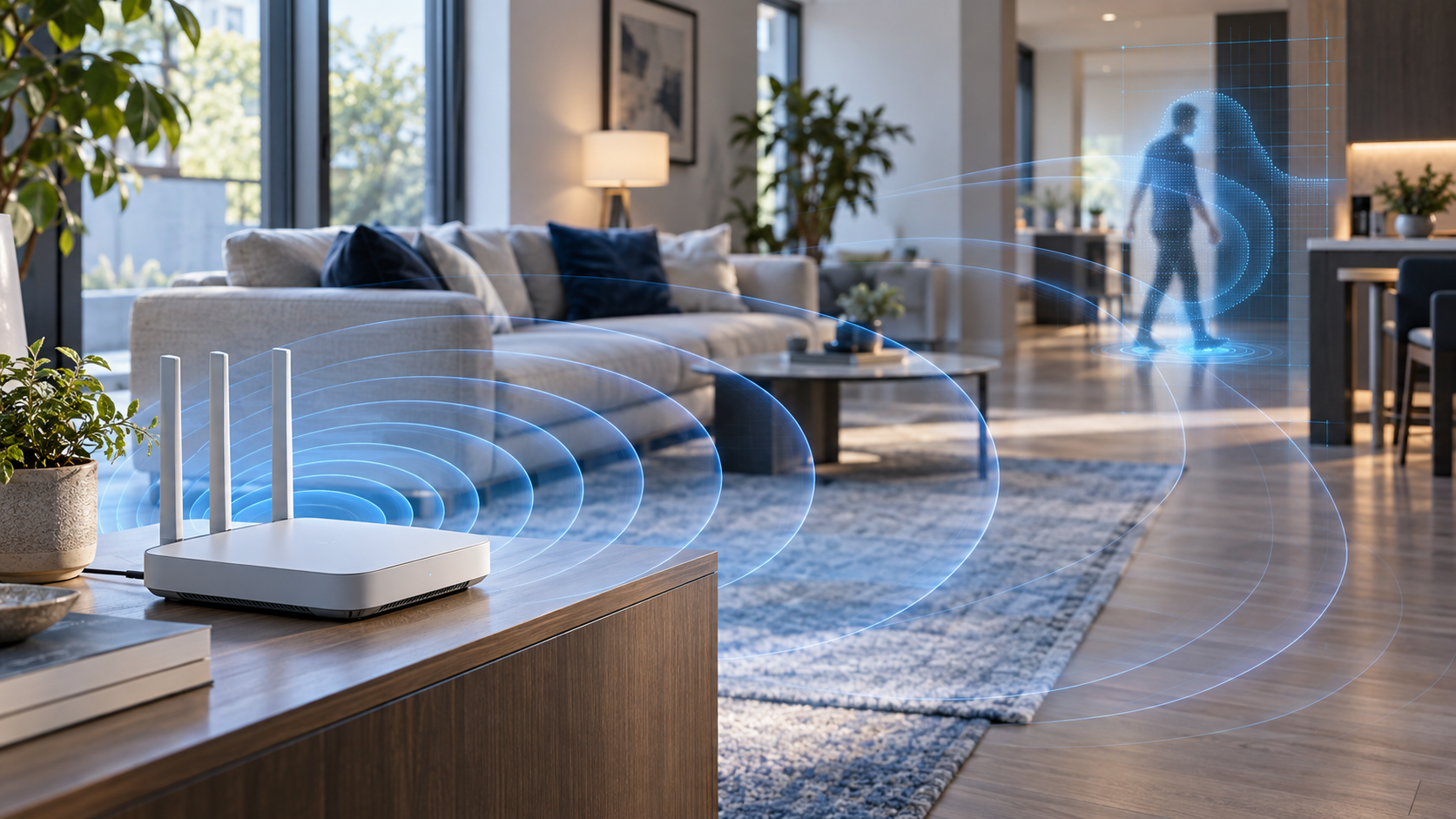
When MIT first demonstrated WiFi imaging in June 2013 many of us got very excited about the potential use cases and applications. Today in 2026, WiFi sensing is a real technology with many of real-world applications offering value add services for users and revenue opportunities for operators.
For many, the idea of a device which can monitor activity around the home in an
opaque way, without requiring cameras is very appealing. Additionally, the fact it
does not require additional specific hardware, reuses the existing infrastructure is
another significant benefit.
So, the big question we are asking is why has not the technology taken off with mass deployments and become a standard feature within our homes?
The fundamentals for the technology are simple to grasp, almost intuitive, looking for a change in signal strength between two WiFi connected devices appears simple when viewed from 50’000 feet. However, the computational processing required to convert these “simple” signal levels into data which accurately maps the whole around it is significant. Early demonstrations used racks of machines processing the data to provide a relatively accurate interpretation of the of what it “saw” and these demonstrations where impressive.
And this is what I believe is at the core of the problem, the processing power required to deliver a credible service is beyond the capabilities of even todays cost
driven router solutions. In an environment where an operator’s biggest customer service issue remains connectivity product managers are constantly chasing network connection speeds and WiFi performance. These are the two big ticket items which sell themselves. Being first to market with a new WiFi standard, positions an operator as a technology market leader and a company to be trusted with providing me, as a user, the best solution for my connectivity requirements. This environment leaves little room for value-add services which add cost but cannot guarantee that return on investment.
But what if there was another, more modular solution, which would enable the
capabilities of the router to be enhanced only for the users who are will to invest in it. The concept of sideloading additional processing power for specific tasks is almost as old as the concept of the processor itself. There are several generic NPU solutions for PC and IoT applications already on the market which prove the concept, but which might not be suitable for a high security application such as a home router or access point. One solution which has been proposed is to harness the CPU and NPU capabilities on the current generation of Set to Boxes which are currently underutilised. The key issue here is the problem of colocation; the router and STB would need to be connected via a high-speed serial interface such as USB 3.0 which is not always practical. An industry specific solution developed by a vendor with specific knowledge of the security requirements, which connected directly on to the router might be the answer, but it is a question not many are asking.
So back to 2013 and the hope this new technology would bring a wealth of new use cases and applications, all we needed was for Moore’s law to catch up and enable the level of processing required inside our humble router. However, what this technology actually needed was for the connectivity issues to be completely solved and 100% reliable so that resources could be allocated to additional vale add services.
Will WiFi imaging ever become a viable value add service? It is hard to make a case for it while connectivity requirements continue to increase and standards continue to evolve.
Leave a Reply